Wuxi Zhongjin Mineral Exploration Tools Co., Ltd.
+8613327923968
Contact Us
  • Tel: +86-13327923968
  • Fax: +86-510-85292629
  • Email: 819375687@qq.com
  • Add: Room 2808, Building A, Columbus Square, Changjiang North Road, Xinwu District, Wuxi City, Jiangsu Prov. P.R.China
What Is Core Barrels


Core barrels are used to bring up rock samples from the drilling operation. The single tube core barrel is the least expensive and most sturdy one with a head section, core recovery tube, a reamer shell, and cutting bit. The standard and most preferred is the double tube core barrel in which the outer barrel rotates with the cutting bit while the inner barrel retains the core sample and is either fixed or swivels on bearings. The core barrel acts as storage for holding the rock or soil core.


Advantages of Core Barrels
 

Time saving
As core drills cut only on the periphery of the hole to be made, it has to remove much less material as compared to conventional drill bits which cut and remove the complete material of the hole. Annular cutters are considered to be 3 to 4 times faster than conventional drill bits. Also while using a twist drill bit or metal hole saw one has to do pre-drilling and step-drilling operations for bigger diameter holes, whereas a broach cutter requires no pre-drilling and step-drilling. It is a one-shot drilling operation. The annular cutters have fewer teeth and less wear, therefore with an annular cutter holes can be made at higher or faster cutting speed and with a faster feed rate of the drilling machine.


Efficient cooling
The cooling of annular cutters is internal. The internal lubrication is provided through a hole with the help of a pilot pin. Internal lubrication makes the annular cutter faster and more efficient for deep hole drilling.


Does not require very powerful machines
As the annular cutter require very low RPM, these cutters can be easily used with light duty drilling machines or portable magnetic base drilling machines.


Sizes
Annular cutters biggest advantage is the variety of sizes. Annular cutters start from 12 mm diameter up to 150 mm diameter and more if required. Various cutting depth (length) of annular cutters can be sourced depending upon the requirement.


Why Choose Us?

Custom Service/Accept ODM/OEM service

Strong product development capabilities and advanced fabrication equipment, can be customized according to customer's special requirements.

Competitive Pricing

We offer our services at affordable rates to make them accessible to many clients. Our pricing is transparent and without any hidden costs.

Professional Team

Our company has advanced CNC processing equipment and a team of experienced drilling and construction machinery engineers. The quality of the product is guaranteed and the production efficiency is improved.

Certificate & Honor

Certified according to ISO 9001:2015 and ISO 14001:2015. Many patents are obtained for continuously innovation..


Types of Core Barrels


TT series core barrel
ultra-thin walld double tube core barrels,available diameters 46 and 56 mm. Very thin cutting face llows very rapid rate of penetration through hard formations. They are suitable forunderground mining applications.

T2 series double tube core barrels
The T2 Series are thin wall double tube core barrel, used for surface exploration, especially mining applications. Due to their thin kerf, these core barrels provide rapid penetration. Available in diameters 46, 56, 66, 76, 86, 101mm.

T6 series double tube core barrels
These are a continuation of the T2 series, but of a sturdier design and available in larger diameters, 76, 86, 101, 116. 131 and 146mm. They are applied in surface mining and geotechnical drilling.

Ltk 48 & Ltk 60 double tube core barrels
The LTK series core barrels system is a thinner wall core barrel than T2 series. They offer a cost effective, high production, which is designed for optimum production and core recovery in medium to extra hard rock formations. Available sizes 48 and 60mm.

WF series double tube core barrels
They are geotechnical core barrels primarily designed for coring relatively soft formations in using face-discharge bits. Simple construction and more resilient to damage than thin-wall barrels, but with slower enetration rate.

TBW and TNW core barrels
These are thin-walled double tube core barrels, as T2 series but with DCDMA hole sizes B and N. Used for surface exploration, specially mining applications. The thin kerf area allows rapid penetration.

Wireline double tube core barrels
Wireline double core barrels are primarily used in deep coring. With an overshot device, they eliminatethe need to couple and uncouple the rod string each time the core is retrieved. Available in DCDMA sizes A, B, N, H ,and P.


The Importance of the Core Barrel


Core barrels are used to bring up rock samples from the drilling operation. Core samples are very important for sampling and conducting soil investigation in order to select appropriate boring methods for laying pipelines.

The starter barrel is used to first begin drilling a test borehole. Sometimes single tube core barrels are also used as starter barrels for beginning the core operation. Once it reaches a sufficient depth, the crew replaces the starter barrel with a regular bit and core barrel to extend the hole to the desired depth. The core is then removed and a casing with stabilizers is inserted.

In addition to the drill, a diamond bit, reamer, and drill rods of appropriate length are necessary. A core breaker, core shovel, and core puller are also part of the drilling equipment apparatus.

Trenchless methods such as horizontal directional drilling (HDD), horizontal auger boring (HAB), microtunneling, and pipe jacking use different types of drill bits and cutters to bore through soil or rock.


Main Functions of Core Barrels
 

Core barrels are cutting devices used to collect the core of the drilled rock. The circular device has an open center portion that retains rock core samples from drilling operations. Core barrels are typically used to cut through extremely hard surfaces, such as rock bottomed sea floors and steel reinforced concrete. Their length varies from 1m to 3m. Core barrels are used when conventional augers are less effective or in conjunction with tapered rock augers for very hard rock drilling. The core barrel is designed with a thin cutting edge to maximize the penetration rate through less contact surface area having to be cut and removed. The main functions of core barrels are to collect sub-surface samples in the shape of core and accompanying sludge material in order to study their mineral assemblage, chemical composition, rock structure, and physical strength for various purposes.

Spit Tube Assembly for Wireline Core Barrel

Working Principle of Core Barrels


Double Tube Core Barrel Assembly

Core barrels are mounted to stabilizing equipment, such as a drilling rig or a truck rig, which can be operated by fewer workers and used for smaller cores. The barrel itself is made from a variety of hardened materials, like steel and titanium that are designed to withstand large amounts of pressure, and features a row of cutting teeth along the bottom edge. The teeth are usually made from similar materials as the drill itself and are often reinforced with additional metals for heavy duty jobs. These drills are manufactured in a variety of sizes and can be designed to the specifications of the purchasing company.

Rotating Core Barrels
 

These barrels are two part drill systems that are comprised of a spinning drill bit which moves around a non-rotating inner core. These core barrels are often used to penetrate the hard, crusty rock at the bottom of the ocean, and are frequently found in use on off shore oil rigs for drilling wells. The drill rests on the surface of the rock and begins spinning down into the hardened sediment. The interior non-rotating core can be inserted periodically to take samples of the rock for analyzing. The stationary core can be removed at any time and replaced with a secondary rotating drill for added force.

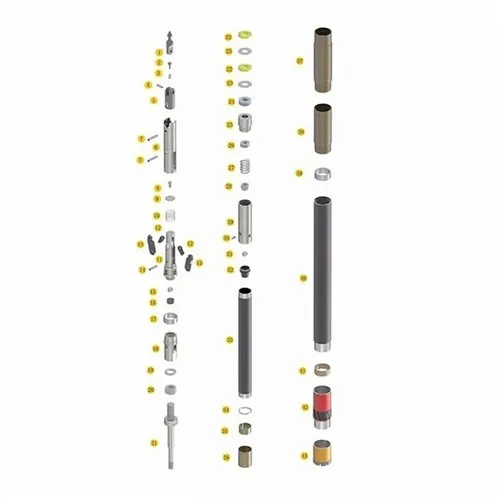
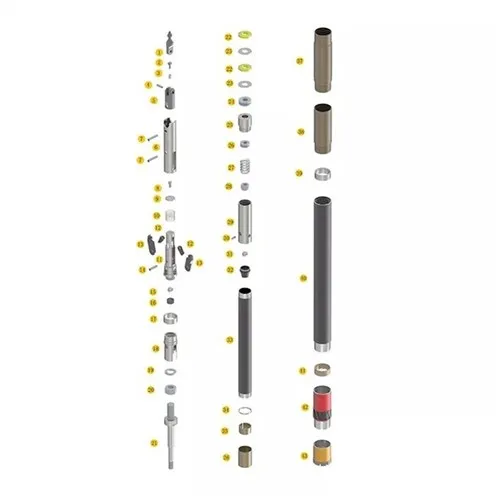
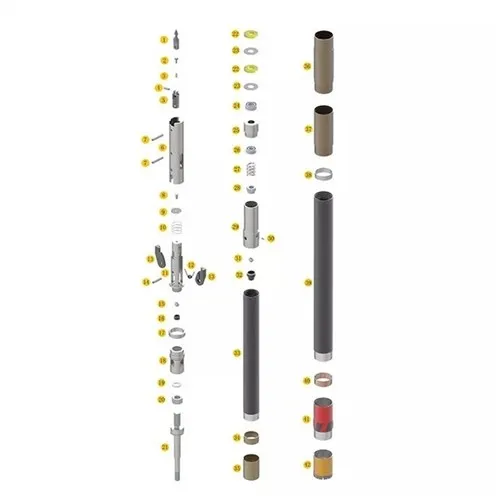
Core Barrel Assembly

Diamond Core Barrels


Core Barrel Assembly

They are similar to the rotating core barrels, and employ an inner and outer core to obtain rock and mineral samples during the drill process. The diamond bit is used when the material is too hard for a standard rotating barrel to penetrate. The diamond core bit may be inserted into the existing well, and then rotate the outer barrel around the inner barrel to cut away the sample. This technique is beneficial in preventing any exterior water from entering the core sample during the extraction process, which is a primary concern when drilling in the ocean.


There Are Three Types of Core Barrels


Functions of single tube core barrels
Single tube core barrels consist of a head section, core recovery tube, reamer shell and a cutting bit. The main functions of these core barrels are they are often used as a starter barrel during the beginning of core operations. They are used in coring homogeneous hard rock formations, where the core does not wash away or crumble easily, and a solid core can be taken without risk of blockage in the barrel. They are also suitable for penetrating rock layers above the strata, where high core recovery is not essential. They are not recommended for drilling friable or easily eroded formation since the core is continually washed by the drilling fluid.

Functions of double tube core barrels
These are the standard core barrels with an outer barrel that rotates with the cutting bit and an inner barrel that is either fixed or swivel type with bearings. This inner barrel retains the core sample. They are used in a wide range of core drilling conditions, and due to their narrow kerf bit, they will give good performance and core recovery in medium hard to extremely hard formations.

Functions of triple core barrels
These core barrels are ideal for obtaining core samples in fractured rock and highly weathered rocks. The outer core barrel initializes the cut, the second barrel cuts the surface to finer size and the third barrel retains the cored samples. Triple core barrels reduce frictional heat that may damage samples. The main functions of core barrels are to penetrate rock layers, cemented gravel and encountering boulders, so they are typically utilized by industrial construction companies and geological survey teams.


Analysis System of Core Barrel


Overshot
The Overshot is dropped or pushed into the drill string to bring back the inner - tube assembly by means of wireline cable hoist.

Locking coupling
The Locking Coupling attaches the drill string to the outer - tube assembly and maintain a mating surface which the head assembly bolt ride against while performing the drilling.
Besides this, locking couplings maintains directional control for the core barrel assembly by means of wear resistant preserving pads that wear down against the drill hole wall.

Adapter coupling
The adapter coupling matches between the locking coupling and core barrel outer-tube, maintaning the pocket into which the head assembly secures deploy.

Head assembly
The head assembly maintains latching and also evoting spearpoint mechanism to grant insertion and bringing back of the inner-tube assembly, a bearing assembly to let on the inner - tube to remain stationary and avert sample damage while driling, fluid pressure operating indications and fluid control valves. All head assemblies integrate a shut off valve assembly which maintains a fluid pressure signal to drill operator, revealing a full or blocked inner-tube.

Landing ring
The Landing Ring sits in the upper-end of the outer tube and is recollected by the mating coupling. As the inner tube assembly trips into drill string, the landing shoulder on the Head Assembly collides the Landing Ring setting the inner tube assembly into drilling position.

Outer-tube
The outer - tube houses the inner-tube assembly and conncets to the diamond products piercing the hole. The increased wall thickness of the outer-tube maintains supplementary rigidity for directional control and a tighter hole annulus for increased fluid velocity and swift cuttings discharging for bit performance. Multiple outer-tubes can be amassed to extend the potential core sample lenght.

Inner-tube
The inner- tube takes the core sample as performing the drilling progresses. Multiple inner-tubes can be amassed with couplers or extensions to get longer core samples.

Inner-tube stabilizer
Installed in the Reaming Shell or in mated outer - tube extensions, the replaceable and reversible inner-tube stabilizer maintains centralizing for advanced sample recovery and a bearing between the stationary inner-tube and the rotating outer-tube.

Core lifter
The core lifter is a pressed steel , split collar with a tapered body that matches to a tapered socket in the core lifter case.
In a core breaking operation, the drill string is climbed off bottom and the core sample starts to slide out of the inner-tube. Grip marks on the inner surface of the core lifter takes the moving core sample and pull the core lifter towards the smaller end of the tapered socket in the core lifter case. The core lifter is compressed againstthe core sample and retainsit after it has crushed, granting retrieval to surface.

Core lifter case
The core lifter case mates to the inner-tube and houses the core lifter in a tapered socket which controls movement of the core lifter. As the drill string is lifted during a core breaking operation, the core lifter case bottoms out on the inside of the drill bit transferring the pullback load from the Drill string to the core lifter until the core sample breaks

Stop ring
The stop ring is a compressed steel snap ring devised to seat into a mating groove, and maintaining the core lifter in the core lifter case.


Wireline Systems
Double Tube Core Barrel Assembly
Core Barrel Assembly
Spit Tube Assembly for Wireline Core Barrel
Core Barrel Assembly

Wireline systems are optimal for use in most drilling conditions and applicable in standard DCDMA hole sizes.
Son- Mak presently offers two models of the wireline core barrel system:

  • O / O 3

O wireline systems, includes the core barrel assembly and the overshot assembly. Both assemblies are essential to the wireline system.

The core barrel assembly is formed by the inner- tube assembly and outer -tube assembly.

The inner - tube assembly is formed:

  • Head assembly
  • Inner - tube
  • Core lifter case
  • Core lifter
  • Stop ring

The inner- tube assembly takes the core sample during the performing of the drilling process and seperate of the outer- tube assembly.
The outer - tube assembly is formed by the remainder of the core barrels components:

  • Locking Coupling
  • Adapter Coupling
  • Outer- tube

The outer tube assembly always stands at the bottom of the hole and houses the inner- tube assembly during the drilling process.
O3 Wireline systems contains the same assemblies as the O but utilize a third tube called an innter - tube liner or split tube.The liner is housed inside the inner- tube.
O3 systems implements integral core recovery when drilling coal, clay bearing or highly fractured formations. The liner, or split tube, contains the core sample in its received state for easier loading into sample trays or for storage and following presentations to the geologist. The O3 system is only applicable in surface configurations and is possible in N Wireline, H Wireline and P Wireline sizes.


Components of Core Barrels


Head assembly
This is the most complex part of the core barrel and it serves several purposes including landing indication, providing circulation of drilling fluids to the core bit and latching the inner tube assembly in place. The latch head mates with the outer tube assembly, and it spins along with the rods. While rotating, the bearings in the head assembly allow the inner tube to stay stationary, to better accept the in-coming core sample. There are several options when choosing latching systems such as the traditional spring latch, Fordia’s V-latch and L-latch, to name a few.

Inner tube
This is the part that receives the core and stores it until it is retrieved. It is available in 5 feet and 10 feet lengths but extensions are also available.

Stop ring
The stop ring is one of three integral parts that accept, hold and break the core sample off from the host rock. The stop ring provides a hardened surface for the core lifter spring to bear against. It is locked into a machined groove in the core lifter case. When the core sample is being recovered, it prevents the core lifter in place, keeping it from being pushed up into the inner tube. In broken ground, it keeps core lifter spring square to the core.

Core lifter spring
The core lifter spring is one of the most important parts for core recovery. It allows the core sample to move into the inner tube as the bit advances in the formation. When advancing, the core lifter spring slides up against the stop ring. In this position the spring is open and allows the core sample to enter unobstructed. Once the tube is full, the driller will pull back on the rod string, this forces the tapered sections of the core lifter spring and core case together, gripping the core firmly.
The inside profile of the core lifter spring comes in two styles, slotted or broached, to ensure a good grip regardless of the ground conditions. A core lifter that is slotted is good for competent rock, whereas a fluted core lifter can provide good recovery in fractured ground.

Core lifter case
The core case houses both the core lifter spring and the stop ring, and is adjusted in relation to the bevel on the inside of the core bit. This adjustment will allow water to flow past the tube to flush the bit. The bevel on the inside of the bit matches the bevel on the core lifter case exactly. When the inner tube is full, the driller will pull back the drill string and this forces the core lifter spring to grip the core as it moves down the taper within the core case. The compression spring in the head assembly allows for the gap between the bit and core case to close, giving support to the inner tube to help break the core.
Of course, there are options when choosing inner tubes and these address specific issues and deliver different performance. For example, you can buy a chrome-plated inner tube that avoids rust and allows the core to enter the tube smoothly and easily.


FAQ


Q: What is a core barrel?

A: A core barrel is a hollow tube used in drilling operations to extract a cylindrical sample of rock, soil, or sediment from the subsurface.

Q: What materials are core barrels made from?

A: Core barrels are typically made from steel or aluminum to withstand the high pressures and abrasive materials encountered underground.

Q: How do core barrels function?

A: During drilling, the core barrel is inserted into the borehole, and as the drill bit cuts through the formation, the core sample is captured inside the barrel.

Q: What types of core barrels are there?

A: Common types include standard wireline core barrels, conventional rotary core barrels, and specialty barrels like PDC (polycrystalline diamond compact) core barrels.

Q: How is a core barrel retrieved after sampling?

A: Once the core sample is collected, the core barrel is brought back to the surface, where the core is extracted for analysis.

Q: Can a core barrel be reused?

A: Core barrels can be reused, but they must be cleaned and inspected between uses to ensure they are free from debris and in good condition.

Q: What determines the length of a core sample?

A: The length of a core sample is limited by the depth of the borehole and the length of the core barrel. Standard lengths vary but can be several feet long.

Q: How is core recovery measured?

A: Core recovery is the ratio of the length of the core sample retrieved to the total length of the interval drilled.

Q: What affects core recovery rates?

A: Factors affecting core recovery include the formation's hardness, fracturing, the presence of fluids, and the drilling method used.

Q: What are the benefits of obtaining core samples?

A: Core samples provide valuable information about the subsurface geology, including rock composition, texture, and structural features.

Q: How are core samples stored and preserved?

A: Core samples are typically stored horizontally in core boxes and preserved in a controlled environment to maintain their integrity for future analysis.

Q: Can core barrels be used in various types of formations?

A: Different core barrel designs are optimized for different formations, from hard rock to unconsolidated sediments.

Q: How do I choose the right core barrel for my project?

A: Selection depends on the type of formation, the depth of the borehole, and the objectives of the core sampling program.

Q: What is core orientation?

A: Core orientation involves recording the azimuth and dip of the core sample to understand the orientation of structures within the formation.

Q: How is core orientation achieved?

A: Core orientation can be accomplished using specialized tools and techniques, such as magnetic or gyroscopic instruments attached to the core barrel.

Q: What challenges might be encountered when using core barrels?

A: Challenges may include core disintegration, poor recovery in loose or fractured formations, and core barrel obstructions.

Q: Can core barrels be adapted for specific needs?

A: Yes, core barrels can be modified or customized with additional features like core catchers or orienting devices.

Q: What is the role of a core sampler in geological exploration?

A: A core sampler operates the core barrel and manages the core extraction process, ensuring the collection of high-quality samples.

Q: How are data from core samples analyzed?

A: Data is analyzed through visual inspection, petrographic studies, geochemical testing, and sometimes micro-computed tomography (micro-CT) scanning.

Q: Are there any environmental considerations associated with core drilling?

A: Yes, environmental factors such as waste management, site remediation, and groundwater protection should be considered to minimize the environmental impact of core drilling activities.

As one of the most professional core barrels manufacturers and suppliers in China, we're featured by quality products and competitive price. Please rest assured to buy the best core barrels for sale here from our factory. Also, custom service is available.

core barrel tensioning devices, overshot lugs, core barrel end caps

(0/10)

clearall